This year’s IFS UK&I User Group Annual Conference carried the theme ENIGMA — “breaking the code and solving complex business challenges together.” Over three days (1–3 June 2026) at the DoubleTree by Hilton, Milton Keynes Stadium, the IFS community gathered for customer stories, industry strategy sessions, peer-to-peer discussion, and a packed programme of partner presentations.

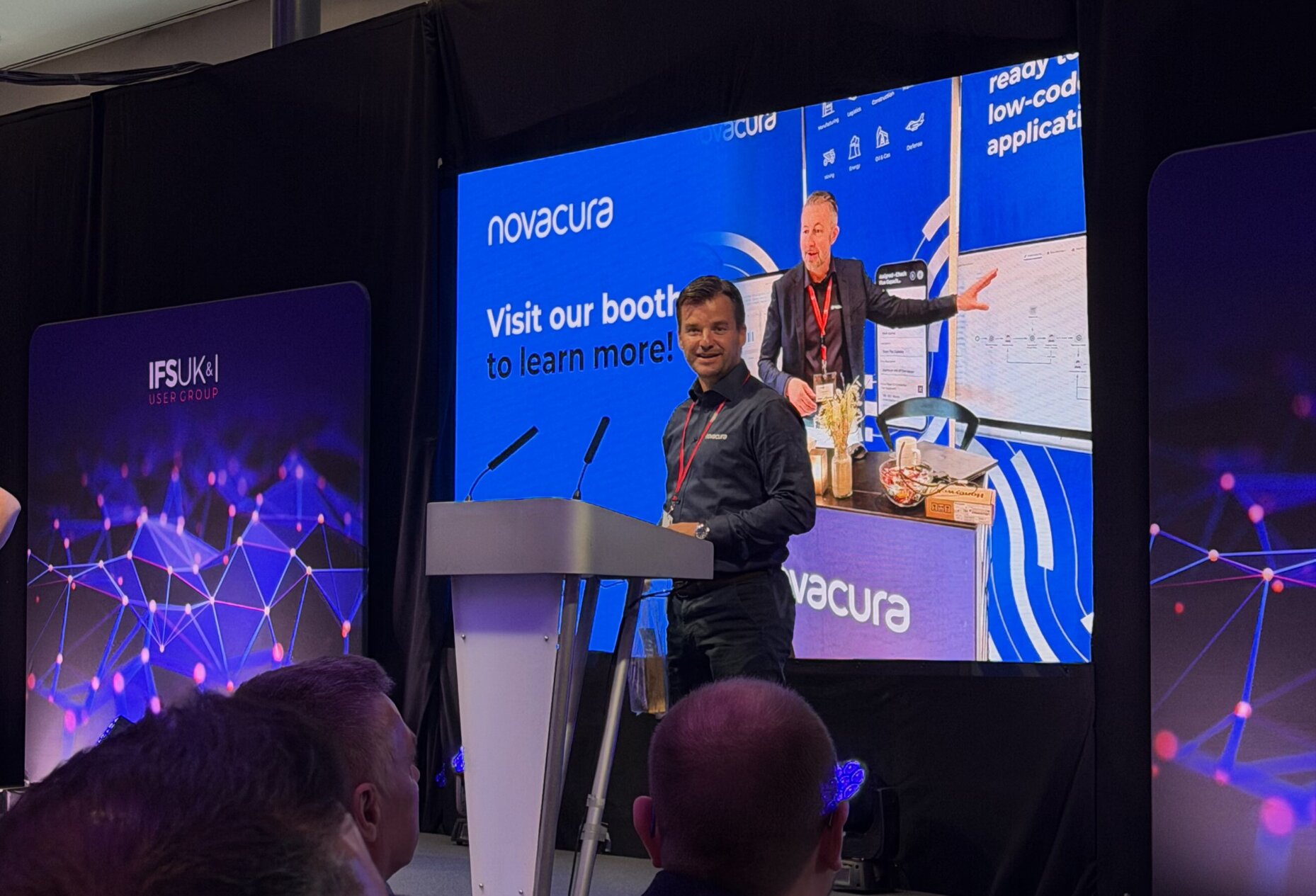
Novacura was proud to take part as a sponsor, with Aksel Jarlbäck and Robin Huizer on site throughout the event — at our stand and on the main stage. As always, our focus was practical: not technology for its own sake, but how IFS customers close the gap between a well-designed process and what actually happens on the floor, in the field, and on the front line.

The "last mile" of field service

The ENIGMA programme made one thing clear: for most organisations, the hard part isn’t the ERP — it’s execution. IFS is a powerful system of record, but value is won or lost in the last mile: the moment a technician arrives on site, runs a safety check, uses a part, captures a reading, and signs off the job.

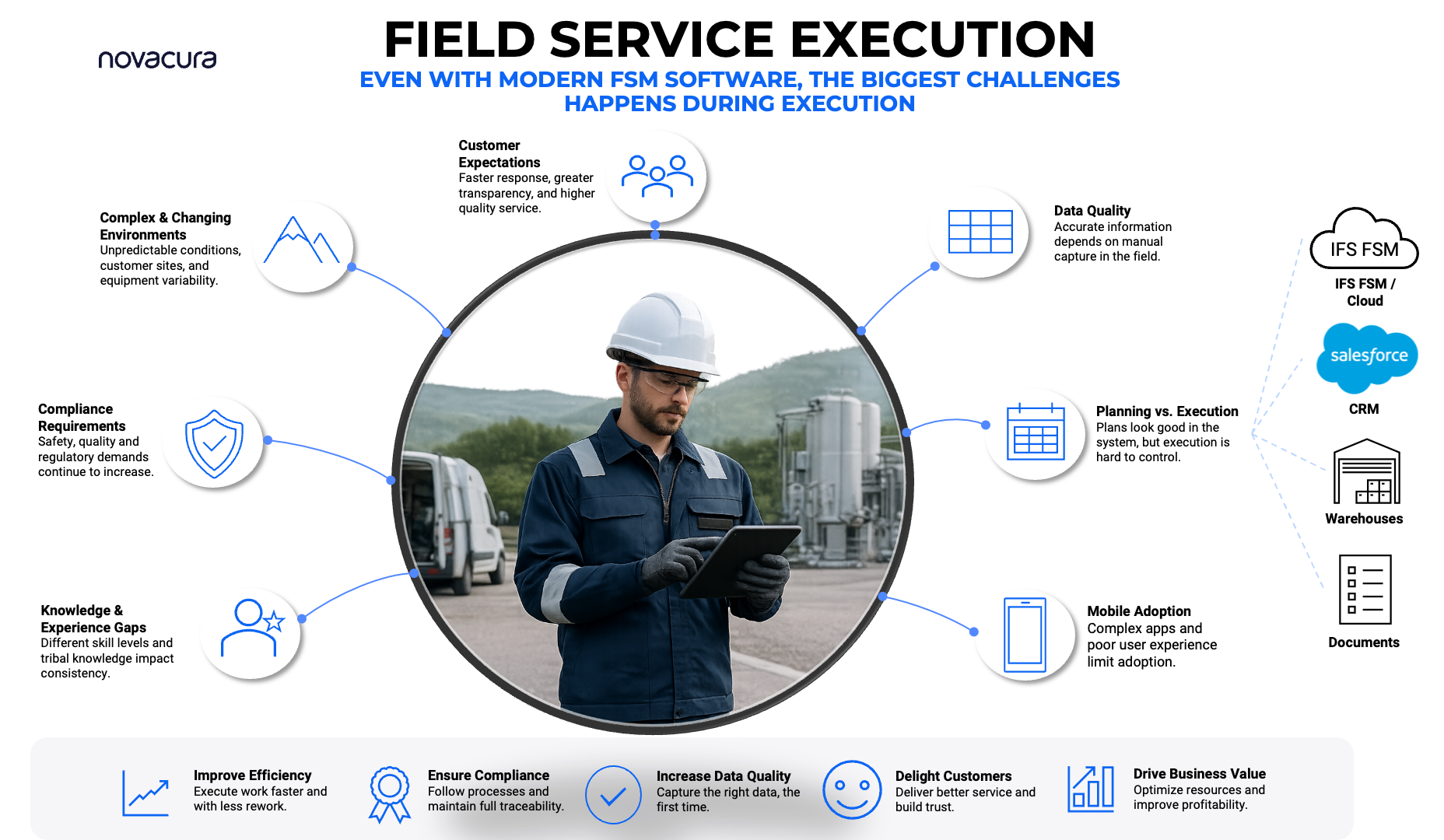
Even with modern field service management software, the biggest challenges tend to appear during execution:

  • Complex, changing environments — unpredictable site conditions and equipment variability.

  • Rising compliance demands — safety, quality, and regulatory requirements that keep increasing.

  • Knowledge and experience gaps — different skill levels and tribal knowledge undermining consistency.

  • Data quality — accurate information still depends on manual capture in the field.

  • Planning versus execution — plans look great in the system, but execution is hard to control.

  • Mobile adoption — complex apps and poor user experience quietly limit uptake.

When those gaps go unaddressed, the cost is familiar: rework, slower billing, compliance risk, and customers left waiting.

Novacura FLow as the execution layer

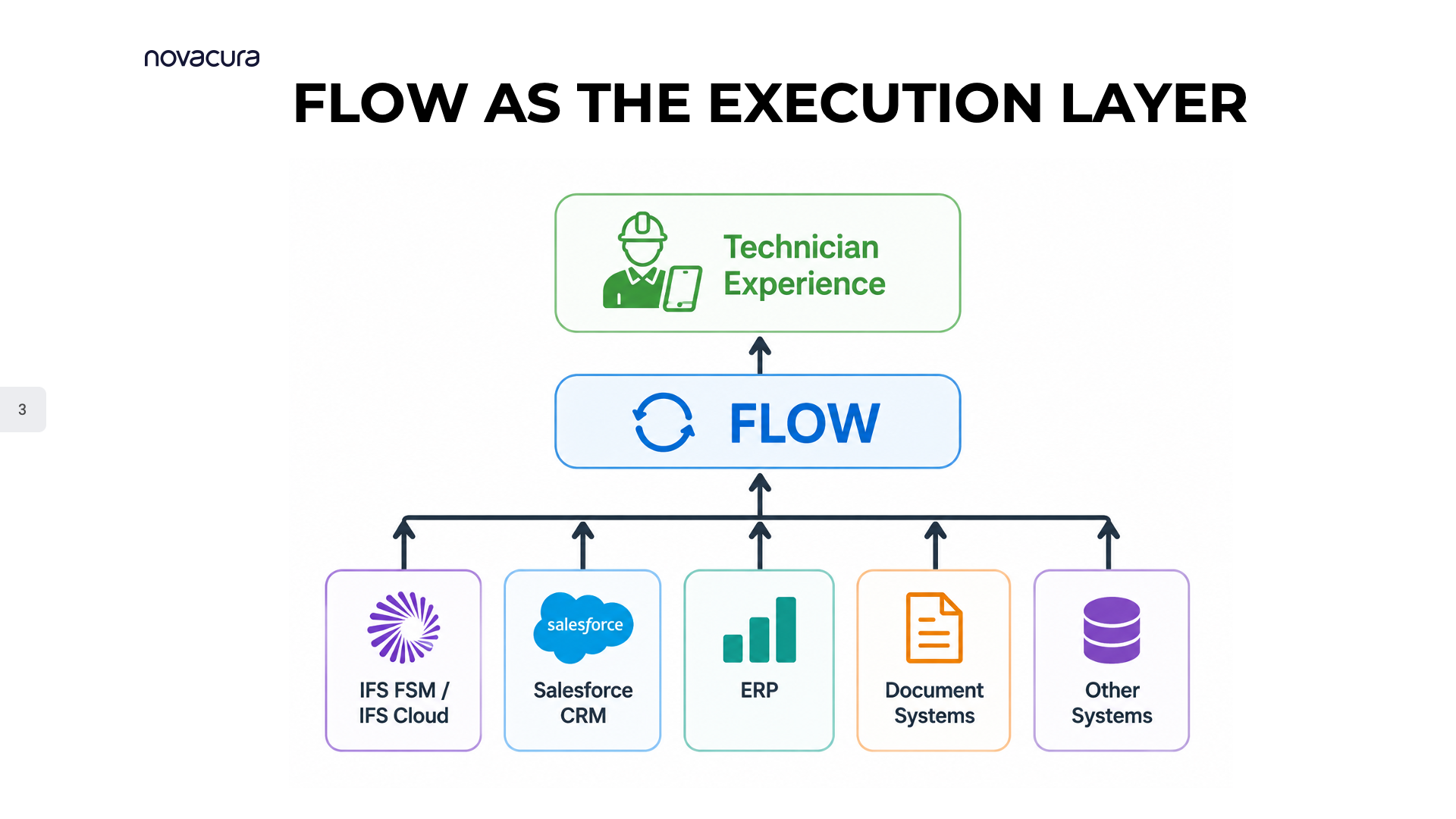
Our answer isn’t to replace or heavily customise IFS — it’s to add a layer on top of it. Novacura Flow acts as an execution layer that sits between the technician and the systems behind them: IFS FSM / IFS Cloud, CRM, ERP, and document systems. It shapes the system around the user’s natural workflow, rather than forcing people to adapt to rigid transaction screens — while IFS remains the single source of truth.

Build once, deploy to anything: phone, tablet, rugged scanner, or desktop. Combined with ready-to-use template apps from the Novacura Marketplace and AI-assisted building, that means minimal time to value.

On stage: Supercharging ifs field service

Our main-stage session, “Supercharging IFS Field Service: A Smarter Execution Layer for Technicians,” presented by Aksel Jarlbäck, showed exactly how this works in practice — walking through a guided, end-to-end field service journey on a technician’s mobile device:

  • Select and review the job from a clear job list, with fully configurable job information, maps, and contacts on hand.
  • Start travel with automatic travel-time tracking.
  • Arrive and run a compliance & safety checklist — arrival triggers the checklist, so safety steps are completed before work begins.
  • Use van stock or order parts — issue from van stock, scan parts, and instantly see which warehouse has availability.
  • Report material and labour at the point of work, keeping IFS updated in real time.
  • Sign, close, and rebook — capture the customer signature, answer closure questions, and book a follow-up visit with reasons recorded if a rebook is needed.

The session also covered how AI is embedded across the Flow lifecycle — from generating workflows out of a plain-language prompt (Flow Builder AI) and assisting with scripts (Flow Script AI), to explaining connectors and workflows (Flow AI Assistant), with performance-based optimisation on the roadmap. The takeaway: automation and AI can be introduced without rebuilding your core.

The outcomes we hear from organisations running Flow for field service tell the story:

  • Higher productivity — work executed faster, with less rework.
  • Better compliance — guided checklists and full traceability.
  • Improved data quality — the right data, captured the first time.
  • Faster, more accurate billing and a better customer experience.

What the community was talking about

Beyond our own session, a few themes ran across the conference — and each connects back to closing the execution gap:

  • Crystal Reports leaving IFS Cloud. With removal planned from 26R2, reporting continuity was a recurring topic — a challenge Novacura Flow Connect also addresses – Read Here!
  • Agentic AI in industrial settings. Sessions explored how to give AI real operational power while keeping consistency, accountability, and human judgement in the loop.
  • The journey to IFS Cloud. Customer after customer shared upgrade lessons — from Apps 9/10 to Cloud — and the reality of doing it without disruption.
  • Adoption and value realisation. A common thread: go-live is the start, not the finish. Sustained value comes from usability, adoption, and continuous improvement.

For us, that’s the whole point of an execution layer — making the everyday work simpler so the investment in IFS keeps paying off.

Looking ahead

Thank you to the IFS UK&I User Group committee for another outstanding conference, and to everyone who stopped by to talk field service, reporting, and execution. 

If the last mile of your IFS field service is where things slow down, let’s talk. Bring your process — we’ll help you map the smarter execution layer around it.

Aksel Jarlbäck

VP Sales, Novacura