

Publications
:
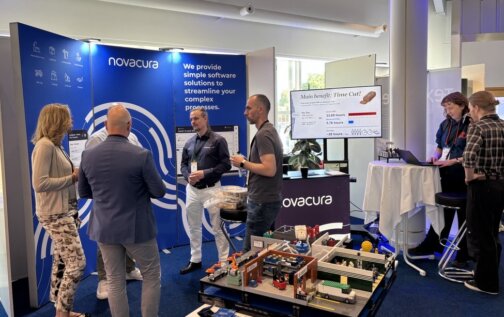

In late May, the Swedish Infor M3 community gathered in Linköping for the Working Together Conference (WTC) 2026, the annual event hosted by the M3 User Association (MAF). Across three days — a training day followed by two conference days — M3 users, partners, and Infor experts met for keynotes, hands-on sessions, and a packed exhibition, all around one shared question: how do you get more value from M3 as the platform moves to the cloud? Novacura was there as a Gold exhibitor, and had the privilege of joining one of our customers on stage. The programme made the mood of the moment clear: sessions on Infor CloudSuite and Cloud Release Management, Process Mining and the Velocity Suite, integration strategy, and — unmistakably — the rise of AI and “agentic” automation across M3. Infor’s own main-stage session was even titled “The Industry Agentic Cloud.” The tension every M3 customer is navigating A theme ran through the whole conference: the move to Infor M3 Cloud pushes organisations toward standard — a “clean core,” with fewer modifications and an easier path to stay evergreen. That’s the right direction. But it raises an important question for anyone running a real operation: if you strip out the customisations, what happens to the tailored, hands-on workflows your people depend on every day — the scanning, the traceability, the line-side reporting that standard screens don’t quite cover? That’s exactly the gap our on-stage session set out to address. WHY THE APPROACH RESONATES Beyond the specifics, the session landed on a pattern many M3 customers in the room recognised — the practical benefits of using an execution layer alongside a standard M3 Cloud core: Build fast, iterate with users. Instead of a 25-page spec written up front, let the team prototype early and refine the solution hand-in-hand with the end users who actually do the work. Developers who speak M3. Building with people who know both M3 and the mobile side made for a smoother, faster implementation. Flexible by design. Workflows can be shaped to each operational reality — and adapted as processes evolve — without touching the ERP core. Where this is heading: AI in Novacura Flow Fittingly for a conference themed around the “agentic cloud,” we also looked ahead — to how AI is being built into Novacura Flow across three levels: a co-pilot for developers that helps build workflows from a plain-language prompt; assisting AI inside the process that guides end users and automates steps (from pre-filling records to conversational, agent-style tasks); and a process-optimisation co-pilot that reads workflow telemetry to surface bottlenecks and unnecessary loops. The through-line: AI that’s deeply integrated with the ERP, and directly, practically applicable — not AI for its own sake. The takeaway Clean core and capable field execution aren’t opposites. As WTC 2026 showed, the winning pattern is to keep M3 standard and let a flexible execution layer handle the last mile — the scanning, traceability, and real-time reporting that operations depend on. You can go to the cloud without losing the shop floor. Thank you to MAF for another excellent Working […]
For years, the promise of Artificial Intelligence in manufacturing has been hindered by a fundamental disconnect. While modern ERPs can predict a machine failure or a supply chain delay with startling accuracy, the “last mile” of that insight – getting a human or a system to actually do something about it – in many cases remains manual, fragmented, and slow. This is the Industrial AI Paradox: we are data-rich but execution-poor. With the introduction of IFS.ai and the 2025 acquisition of TheLoops — now integrated as IFS Loops — ERP is evolving into something fundamentally different: a system of action, capable of autonomous execution, real-time decision-making, and continuous operational orchestration. This shift is not incremental. It is architectural. IFS.ai: Intelligence As An Infrastructure IFS has fundamentally rejected the “AI-as-an-add-on” philosophy. Through IFS.ai, they have built an infrastructure where artificial intelligence is a core component of the ERP architecture. This isn’t just about generating text; it’s about industrial-grade predictive and prescriptive logic. For a Logistics Manager, this means the system doesn’t just record that a shipment is late. IFS.ai analyzes the impact of that delay on downstream production schedules, evaluates the shelf-life of the raw materials involved, and recommends a specific rerouting strategy to minimize financial loss. It is pervasive, touching everything from Enterprise Asset Management (EAM) to Service Management. For more insights on IFS.ai check out: IFS Cloud – IFS.ai The Strategic Shift: Why IFS Acquired TheLoops To understand where industrial software is heading, we must look at the 2025 acquisition of TheLoops. Traditional ERP systems act as “systems of record,” storing and reporting data after events occur. With the emergence of agentic AI platforms like IFS Loops, ERP evolves into a system of action — autonomously executing multi-system processes and making context-driven decisions while humans focus on high-value exceptions. IFS Loops: The Rise of the Digital Worker IFS Loops introduces the concept of the Digital Workers, specialized autonomous AI agents capable of context-aware decision making and execution across enterprise systems. Unlike rigid RPA scripts, they dynamically plan and perform complex tasks such as order management or maintenance scheduling with significant operational impact. To understand the breadth of this technology, we can categorize these agents by the operational “Villains” they defeat: The Supplier Order Manager (The Procurement Sentinel): In a traditional setup, if a supplier changes a delivery date via email or a portal, a human must read the notification, check the ERP, assess the impact on production, and manually update the purchase order. The Loop: The Digital Worker monitors these external signals autonomously. It identifies a 48-hour delay, cross-references it with current safety stock levels in IFS Cloud, and—if the delay doesn’t risk a line-stop—it updates the PO and notifies the planner. If it does risk a line-stop, it automatically flags the exception for immediate human intervention. The Demand & Inventory Replenisher (The Capital Optimizer): Manual replenishment often relies on “gut feeling” or static reorder points that don’t account for seasonality or sudden market shifts. The Loop: This agent continuously analyzes consumption patterns against external market signals. If it detects a trend—for example, a sudden spike in demand for a specific […]