Almost every enterprise IT leader has heard the pitch by now: write down what you want, and AI will build the app for you in minutes. “Vibe coding” – building software by prompting an AI rather than writing code – promises to finally close the gap between what the business needs and what IT can deliver.

It’s a compelling promise. But for mid-sized and large enterprises, where applications need to talk to ERP systems, respect data governance, and stay reliable for years, the question isn’t whether AI can generate an app quickly. It’s whether that app can be trusted to run your business.

When Vibe Coding Meets Reality

The productivity gains from AI-assisted development are real. So are the growing pains. As more AI-generated code lands in production systems, a consistent set of problems keeps surfacing:

  • Security – AI models can confidently generate code that looks correct but contains exploitable flaws, often without any obvious warning sign.
  • Maintainability – Code produced without an underlying architecture tends to become “disposable”: easy to generate, hard to extend, and expensive to fix once it’s live.
  • Compliance – Regulations like the EU AI Act are starting to hold organizations accountable for how AI-generated systems behave, not just how fast they were built.
  • Deployment – Freely generated apps often have no consistent path to production, versioning, or rollback.
  • Transparency – When nobody can explain why an AI-built application does what it does, auditing and troubleshooting become guesswork.

None of this means AI-assisted development is a bad idea. It means it needs a framework.

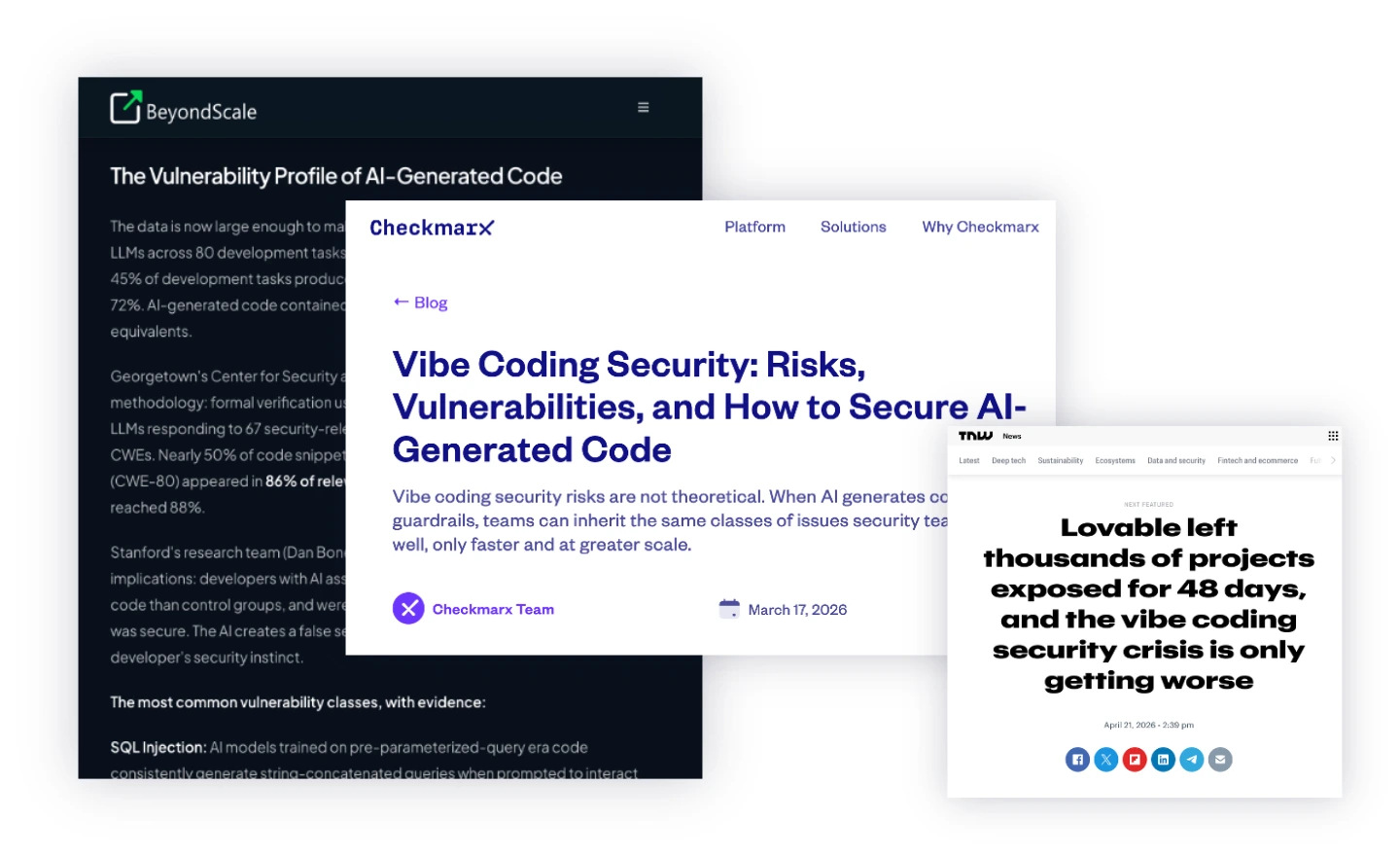
An overlapping collage of three digital article snippets focusing on AI-generated code vulnerabilities and "vibe coding" security risks.

What AI On Rails Actually Is

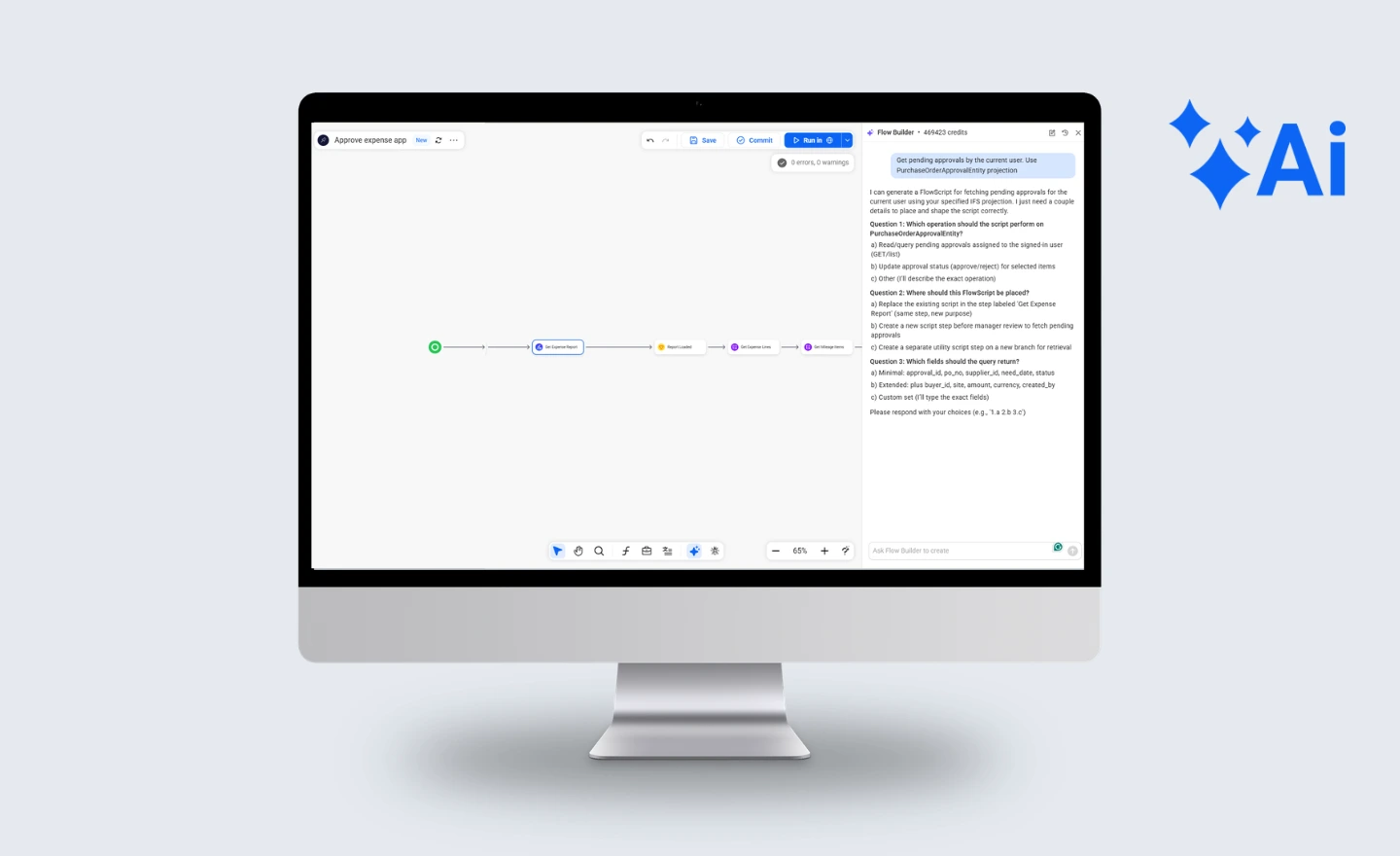
Novacura Flow includes an AI application builder – customers describe a workflow in plain language and get back a working, ERP-connected app. That much sounds like every other AI app builder on the market. The difference is what happens underneath.

Instead of generating raw, freeform code, the AI in Novacura Flow generates a workflow – a structured sequence of steps assembled from Flow’s own components, connectors, and runtime primitives. It isn’t writing arbitrary source code that could do anything a programming language allows; it’s composing an application out of a fixed, pre-approved vocabulary that the platform already knows how to run safely. That’s also why the “rails” framing holds up rather than being just a marketing label: the AI has real creative latitude in how it sequences and configures those building blocks, but it never gets access to the primitives it would need to step outside them – there’s no raw database connection to write, no custom authentication logic to invent, no unmanaged way to reach an external system.

Which is why it stays on rails: not because the AI has been instructed to behave, but because the architecture doesn’t give it anywhere else to go. Every AI-generated app automatically inherits the same runtime engine, the same managed connector pool, the same user and role model, and the same versioning and deployment pipeline as an app built by hand. The AI is never in a position to define its own security model or invent a new way of talking to your ERP – those decisions were made once, at the platform level, and every app it produces runs inside them by default. What would normally depend on a developer remembering the rules becomes something the AI simply has no way to violate.

What The Framework Actually Controls

In practice, “AI on Rails” isn’t a slogan – it’s a specific set of guardrails every AI-generated Novacura Flow app runs inside:

  • A shared, secure runtime – Every app uses the same underlying engine, which handles authentication, encrypted data storage, and stable connections to your database and ERP – none of that is left to the AI to improvise.
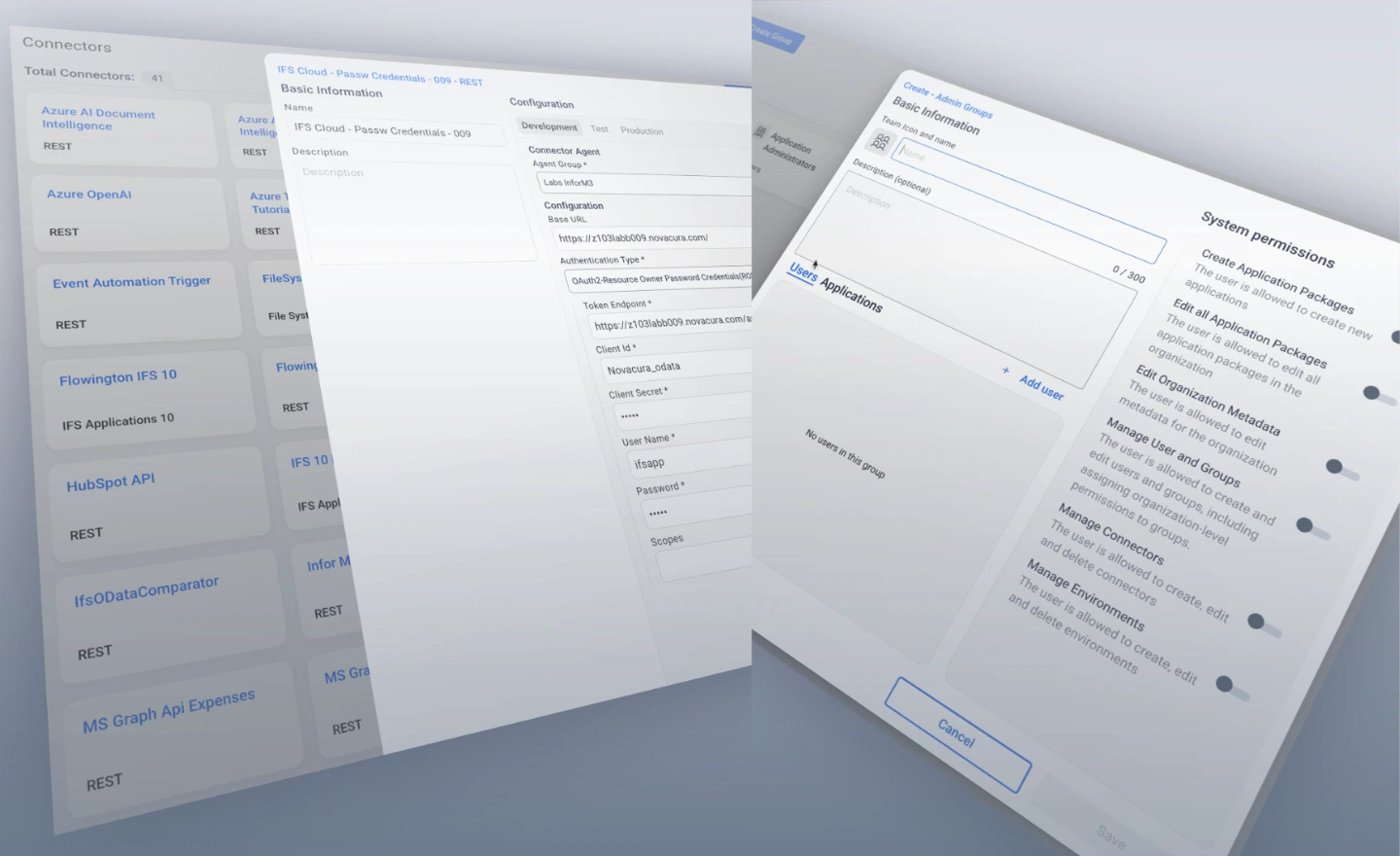
  • Centralized user and role management – Access, sessions, and permissions are governed by the framework, not baked ad hoc into each app.
  • Visual, auditable workflows – Every AI-generated app is represented as a workflow diagram, so developers can actually see and verify the logic instead of trusting a black box.
  • Controlled ERP connectivity – Apps can only reach external systems through a managed pool of connectors configured by an administrator – the AI can’t quietly change how an app talks to your ERP. Connectors also support user impersonation, so each person only ever sees and modifies the ERP data they’re already entitled to.
  • Reusable components – Common logic, navigation, and sub-workflows are shared across apps instead of being reinvented (and duplicated) every time, keeping large app portfolios consistent.
  • Real environment management – Dev, test, and production environments, version history, and the ability to roll back a bad release – the same discipline you’d expect from traditional software delivery.
  • Governed background automation – Scheduled or event-triggered processes run with built-in throttling, so an AI-built integration can’t accidentally overload your ERP.
  • Consistent look, feel, and distribution – Every AI-generated app follows the same UI rules and is pushed straight to end-user devices — no manual app-store publishing, no inconsistent interfaces for users to relearn.

Purpose-Built For ERP, Not Generic Apps

Generic AI app builders are trained broadly. They don’t know the difference between how your ERP expects a purchase requisition to flow versus how a generic web form might handle it. That gap is exactly what the ERP Fusion Engine behind Novacura Flow is built to close – a domain-specific AI model trained on ERP processes, terminology, business logic, and API structures.

The practical effect: apps generated with Flow are far more likely to follow standard ERP processes, use the naming your users already recognize, and call the correct API endpoints on the first try — instead of technically working while quietly drifting away from how your ERP actually operates underneath.

Practical Application of AI With Novacura Flow

The concept is one thing; using it day to day is another. In practice, “AI on Rails” shows up as a set of very concrete capabilities for teams already living inside ERP systems:

  • Prompt-to-app for real ERP processes – Describe a workflow in plain language – say, a manager-driven work order assignment process – and get a working, ERP-connected app back as a reviewable, editable workflow, not a black box.
  • An ERP-literate copilot for developers – Rather than digging through API documentation, developers can ask directly how a given ERP process works, or have the correct integration script generated for them, based on the same ERP knowledge base that powers app generation.
  • Guided upgrades and migrations – AI-assisted tooling can translate older integration logic into current, cloud-ready equivalents, and flag exactly where ERP API changes across versions might affect an existing app – turning what used to be manual migration work into a much faster, guided process.
  • AI-assisted data handling inside apps – Beyond building the app itself, AI can be used within apps to read data from documents like invoices and delivery notes, classify transactions from free-text input, and clean up master data – extending AI’s usefulness past development and into daily operations.
  • A running start instead of a blank page – A growing library of ready-made, ERP-aligned industrial applications means teams often don’t start from zero – they start from a proven app and let AI adapt it to their specific process.
  • Shop-floor-ready by default -Because the framework already includes offline mode, barcode and RFID support, GPS, and industrial device connectivity (PLC, OPC-UA, BLE), AI-generated apps are usable in warehouses and on production floors from day one — not just in office settings.

The Bottom Line

Enterprises shouldn’t have to choose between the speed AI promises and the control their systems require. That’s the entire point of putting AI on Rails: it lets you build faster without quietly signing up for the security gaps, technical debt, and compliance headaches that come with letting AI run free in production. With the right framework underneath it, AI-assisted development can be exactly as fast as the hype suggests – and still be something your IT team is comfortable standing behind.

Łukasz Majer

Business Solutions Director at Novacura