 February 11, 2026
  8 min to read
 IFS has fundamentally rejected the “AI-as-an-add-on” philosophy. Through IFS.ai, they have built an infrastructure where artificial intelligence is a core component of the ERP architecture. This isn’t just about generating text; it’s about industrial-grade predictive and prescriptive logic.
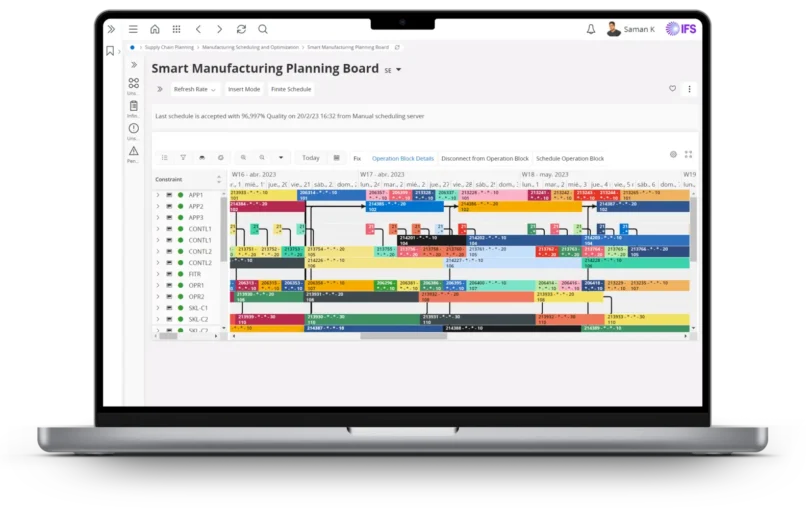
For a Logistics Manager, this means the system doesn’t just record that a shipment is late. IFS.ai analyzes the impact of that delay on downstream production schedules, evaluates the shelf-life of the raw materials involved, and recommends a specific rerouting strategy to minimize financial loss. It is pervasive, touching everything from Enterprise Asset Management (EAM) to Service Management.
For more insights on IFS.ai check out: IFS Cloud – IFS.ai
IFS Loops: The Rise of the Digital Worker
IFS Loops introduces the concept of the Digital Workers, specialized autonomous AI agents capable of context-aware decision making and execution across enterprise systems. Unlike rigid RPA scripts, they dynamically plan and perform complex tasks such as order management or maintenance scheduling with significant operational impact.
To understand the breadth of this technology, we can categorize these agents by the operational “Villains” they defeat:
- The Supplier Order Manager (The Procurement Sentinel): In a traditional setup, if a supplier changes a delivery date via email or a portal, a human must read the notification, check the ERP, assess the impact on production, and manually update the purchase order. The Loop: The Digital Worker monitors these external signals autonomously. It identifies a 48-hour delay, cross-references it with current safety stock levels in IFS Cloud, and—if the delay doesn’t risk a line-stop—it updates the PO and notifies the planner. If it does risk a line-stop, it automatically flags the exception for immediate human intervention.
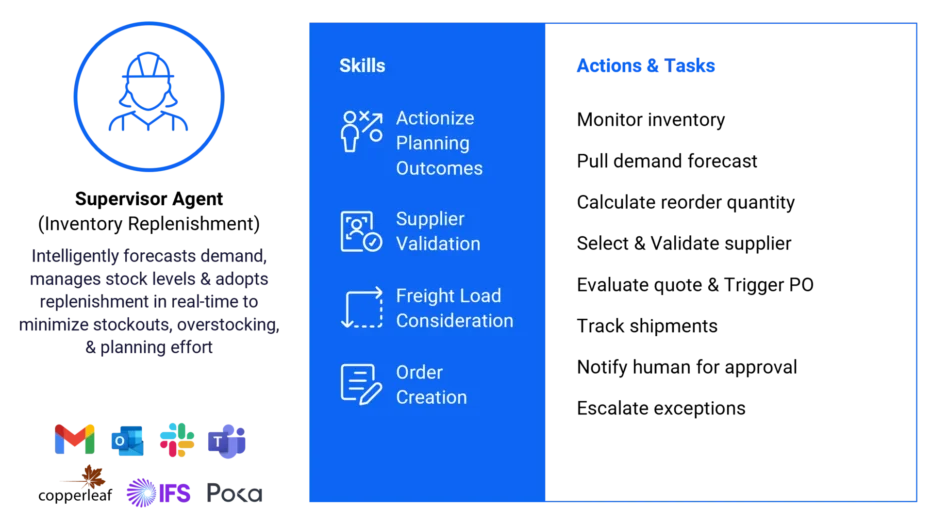
- The Demand & Inventory Replenisher (The Capital Optimizer): Manual replenishment often relies on “gut feeling” or static reorder points that don’t account for seasonality or sudden market shifts. The Loop: This agent continuously analyzes consumption patterns against external market signals. If it detects a trend—for example, a sudden spike in demand for a specific spare part in a certain region—it can autonomously initiate a transfer order from a central hub to a local warehouse, ensuring availability without overstocking.
- The Maintenance Dispatcher (The Uptime Guardian): Usually, maintenance is a game of “telephone” between an IoT sensor, a dashboard, and a scheduler. The Loop: When a machine vibration sensor hits a critical threshold (the Signal), this Digital Worker doesn’t just send an alert. It checks the technician’s schedule for the specialized skill set required, verifies part availability in the warehouse, and drafts the Work Order. It effectively “triages” the technical health of the factory in real-time.
- The Customer Service Advocate (The Experience Enhancer): Tracking “where is my order” is one of the most significant time-sinks for logistics teams. The Loop: This agent monitors shipment tracking data. If a delay occurs at a port, it calculates the new estimated time of arrival (ETA) and proactively sends an update to the customer via the portal or email—often before the customer even realizes there is a delay.
By automating routine coordination tasks, Digital Workers free skilled personnel from data gathering and repetitive updates, boosting throughput, lowering error rates, and enabling teams to focus on strategic decision-making and exception handling.
For more insights on IFS Loops check out: IFS Cloud – Loops
With IFS Loops embedded in IFS Cloud, ERP evolves from passive infrastructure into an active operational engine.
For manufacturers and service organizations, this means:
-
Automatic rescheduling when disruptions occur
-
Autonomous spare parts reordering
-
AI-driven maintenance coordination
-
Intelligent case resolution in service operations
This is not dashboard AI.
This is operational AI.
While IFS Loops provides the AI execution layer, Novacura Flow Connect serves as a rugged execution layer bridging industrial workflows — capturing data, translating AI triggers into actionable tasks on rugged devices, and orchestrating cross-system processes, including legacy systems. This addresses the real industrial “last mile”.
Flow Connect serves as the process-optimizing layer that makes AI actionable in three specific ways:
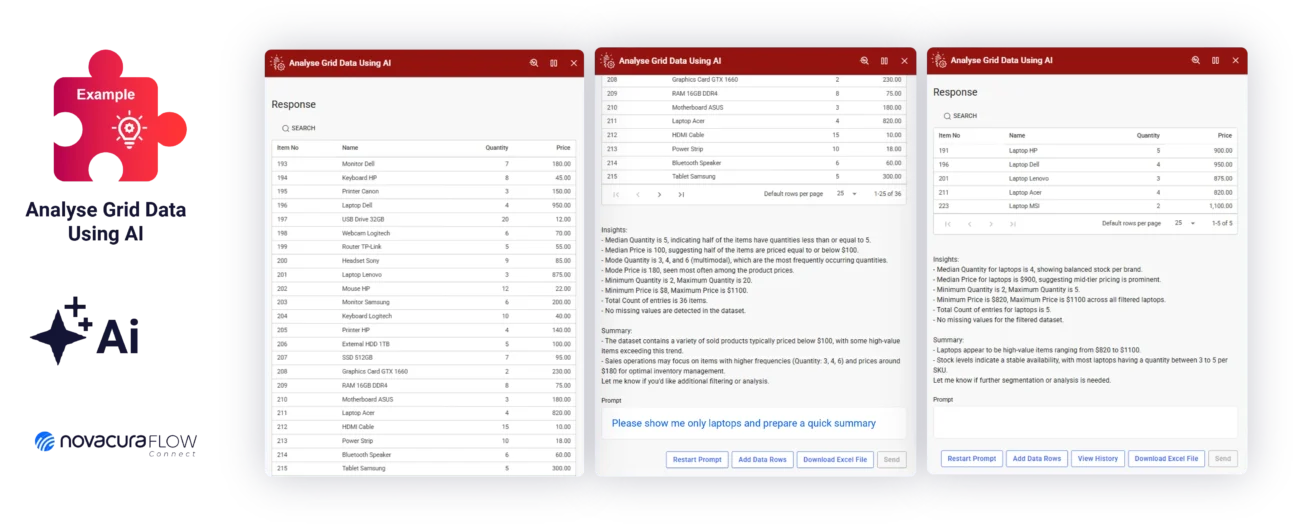
- AI-Enhanced Data Capture (OCR & Normalization): AI is only as good as the data it consumes. Through the Novacura Marketplace, companies can deploy “Ready-Made AI Solutions” that use OCR to scan incoming supplier invoices. Flow doesn’t just “read” the text; it uses AI to normalize the data (e.g., converting “units” to “kilograms” based on ERP logic) before it ever reaches IFS, ensuring the Digital Workers are acting on accurate information.
- Bridging the “Last Mile” UI: A predictive maintenance alert generated by IFS.ai is useless if it stays in the back office. Flow Connect can intercept that AI trigger and instantly push a guided workflow to a technician’s mobile device. The technician sees a simplified interface that tells them exactly what to do and which parts to take, ensuring the AI’s insight leads to a physical result.
- Cross-Ecosystem Orchestration: Most manufacturers operate in a “hybrid” reality. Flow Connect acts as the “Universal Connector,” allowing an AI-driven decision in IFS Loops to trigger an update in a legacy MES or a third-party CRM, ensuring the “Loop” isn’t broken by a software boundary.